

At the risk of giving away my age, I must ask the question. Do you remember…(not the 21st Night of September) but the year 2012?
More specifically, the misinterpreted Mayan predictions that the world would end on the 21st of December?
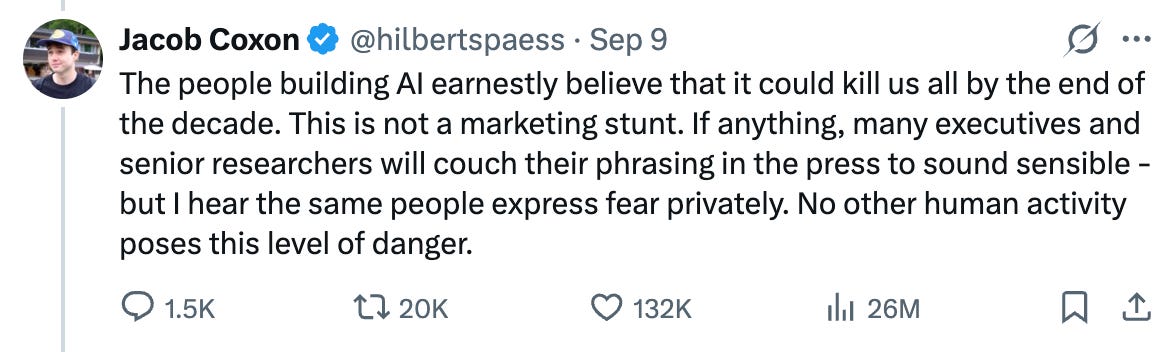
That was my initial reaction to the seemingly ominous X post from Jacob Coxon, a now-former researcher at Anthropic who warned that AI could kill us by the end of the decade.
In the spirit of critical thinking, I recommend reading the whole thread linked above.
But for now, stick around for a far less gloomy outlook. Why so optimistic, you may ask?
Because I have a Humanities background (and yes, I consider that to be a flex!) and a philosophical belief in the resilience and ingenuity of Humanitas. Plus, Humans are as stubborn and resistant to change as they are ingenious.
Let’s look at what is happening on the ground of AI adoption. According to the UK Department for Science, Innovation and Technology (DSIT) report, AI adoption is still varied by business size and sector, with Agentic AI still quite limited. The data tells one story. Real-life conversations tell another. There are companies out there that are still evaluating which providers to use and exploring use cases per business function.
All of this to say, as humans, we are still in the early stages of maximising AI’s full potential. I am fully cognizant that for those working in its development, there have been quantum (pun intended!) leaps: AI in robotics, machinery, all of which I still embrace with excitement.
AI and Machines don’t (yet!) exist independently of human systems. Humans decide where to deploy them, what access to give them, what data they can access, and what happens when they fail.
And that matters because an identity isn't dangerous simply because it exists; it becomes consequential when it has access, privileges and the ability to act on one’s behalf.
Having said that, my intention is not to minimise risk, of which there are genuinely pressing ones at present.
What actually worries me for individuals and organisations alike
Being in the identity security space, what concerns me most is the identity and access layer, particularly as AI systems increasingly gain access to the same resources humans do.
Some industry research estimates that Non-Human Identities (AI and/or Machine) outnumber humans by over 100:1. And as the number of identities grows, so does the potential attack surface. Drafting an e-mail with a diplomatic tone or enquiring why the guy is ghosting you is a relatively low-stakes activity compared to accessing our health and financial information and making decisions from it.
Though not at Jacob’s Terminator-level fears, at an organisational level, we've already seen glimpses of this class of risk: AI agents interacting with real systems can create unintended consequences when their permissions, instructions and environment don't behave as expected - hello, Hugging Face!
And I’m sure that I will have plenty more to share as I work through my learning roadmap outlined in the previous post.
But for now, in true British style, everyone, Keep Calm and Carry On!
Until next time!